Blog Article
Nice Weather Outlook Explained: Decent to Perfect Levels
How the Nice Weather outlook scores comfort from Decent to Perfect, what temperature, rain, smoke and UV do to the score, and how to plan your week.
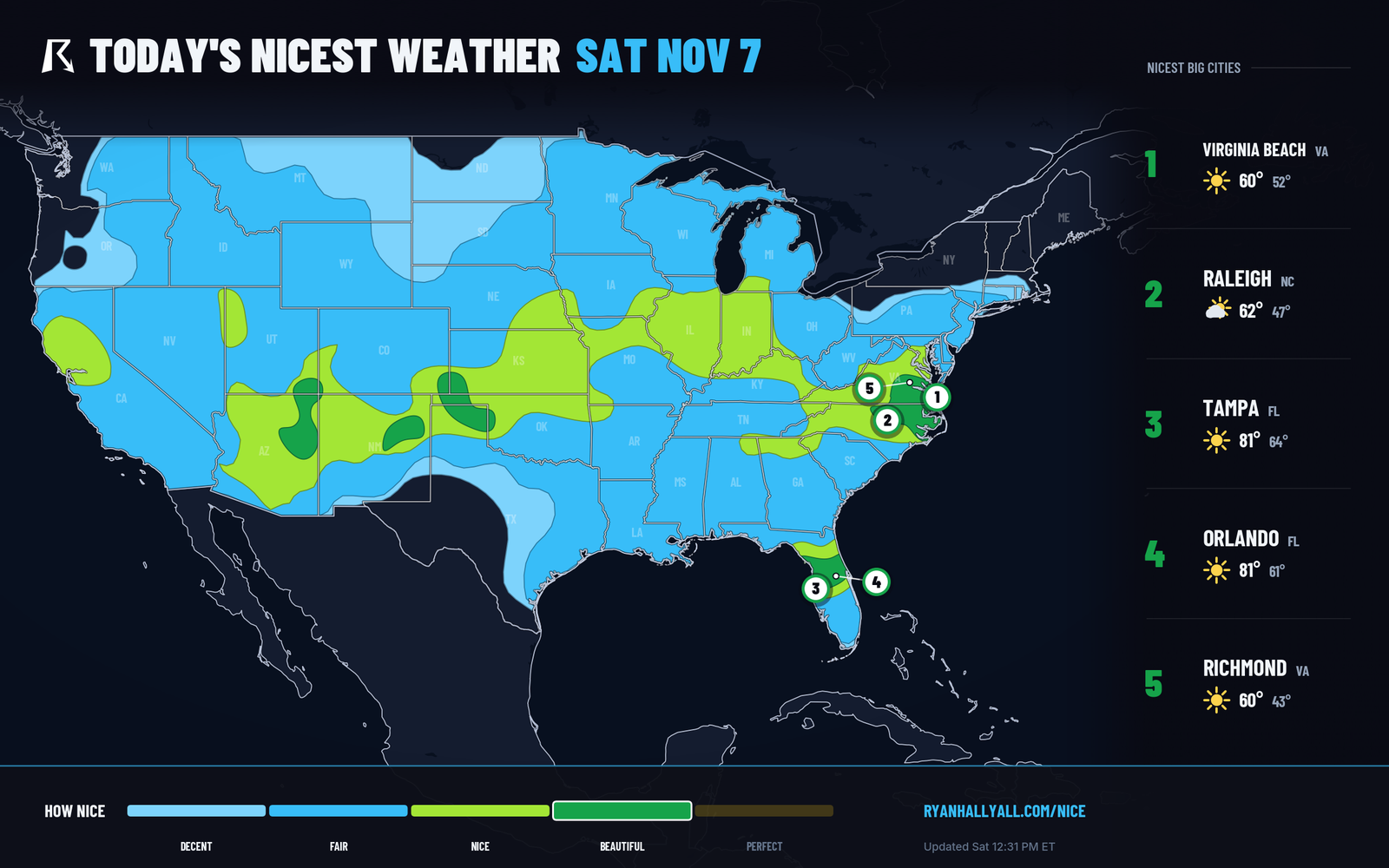
What the Nice Weather outlook levels mean, from Decent to Perfect
Our Nice Weather outlook shows where across the United States the weather will be most pleasant for being outside over the next 7 days. It uses five levels, from Decent at the bottom to Perfect at the top, and each one is a score for how comfortable the day should feel in that spot. It is an experimental, unofficial product from our team. It is not an official National Weather Service forecast.
The short version
- Think of it as the opposite of a severe weather outlook. It shows where the best weather is, not where the danger is.
- The levels, lowest to highest, are Decent, Fair, Nice, Beautiful and Perfect.
- Temperature counts most, then rain. Temperature is judged against what is normal for that place and time of year, while rain is judged by how likely the day is to stay dry.
- Higher levels also need good air quality and manageable UV, and smoke can hold a day down.
- Storms, strong gusts and dangerous heat are never called nice, no matter how sunny the map looks.
What goes into the score
The outlook blends several ingredients into one comfort score for each day. Here they are, heaviest first.
- Temperature. This is the biggest piece. It is scored against the normal for that location and month, not against one national number. An 88°F afternoon in Miami in May is normal and scores well. The same 88°F in Maine in May is a real shock and scores poorly. Dangerously hot or cold days are capped no matter what is normal there.
- Rain. This is the second biggest piece. Even a moderate chance of rain pulls the score down by a good bit.
- Heat stress. On hot, muggy days, how hot it feels can remove an area from the outlook altogether because being outside is not safe.
- Humidity. Low dewpoints mean air that feels pleasant instead of sticky.
- Clouds. Clear to partly cloudy skies score best.
- Wind. A light to moderate breeze barely matters. Strong steady wind or gusts can drag a score down fast.
Because temperature and rain carry so much weight, Decent and Fair are within reach on any day with reasonable temperatures and low rain chances.
What the five levels mean
Above, an example of what the map looks like. Each level sits inside the one below it, so a Perfect zone is also inside the Beautiful, Nice, Fair and Decent zones.
- Decent: you will be fine outside, but it is nothing special.
- Fair: a reasonably pleasant day, comfortable enough and mostly dry.
- Nice: a solidly pleasant day with the main comfort factors lining up.
- Beautiful: hard to find a complaint. Warm, sunny, light wind, low humidity.
- Perfect: once-or-twice-a-season weather, with every ingredient ideal.
Why the top levels are harder to reach
To climb above Fair, every comfort factor has to be solid. Two more checks kick in as well.
UV index is one. Strong sun can keep an otherwise lovely day from reaching the top categories.
Air quality is the other. Smoke, ozone or other problems can cap how high a day ranks, even when the temperature and rain chances look great. Satellite analysis provides a separate smoke check on Day 1, while short-range surface-smoke guidance feeds into Days 1 and 2. Rising smoke near the ground gradually lowers the score. Unhealthy air can take an area out of the outlook entirely.
Failing one of these checks does not necessarily drop you off the map. It just limits how high the day can go.
Why the best levels only show up early in the week
The further out a forecast goes, the less certain it is, so the outlook caps its top levels by day. Perfect is only possible for the first two days. Beautiful is possible through the third day. Days 4 through 7 top out at Nice. A broad area of Fair or Nice on a later day is a good sign that the overall pattern is friendly, but it is not a promise about any single afternoon.
Why some maps have holes
Sometimes a level has a cutout inside it. A big Fair zone across the Plains and Rockies might have a hole over the Front Range near Denver. That is not a mistake. It means the score really does dip below that level inside the hole, say from cold, rain or heavy clouds, while the cities around it still pass. Very small noisy dips get smoothed out, and larger regional dips stay on the map.
What to do
- Pick the day, then the place. If you have flexibility for a hike, a ballgame or a trip, scan the week and choose the day with the highest level near you.
- Treat days 4 through 7 as a trend. Use them to plan roughly, then check again as the day gets closer.
- Check air quality before big efforts. A day capped by smoke or poor air may be a better one for an easy walk than a long run.
- Don't plan around a nice score if storms are in play. The outlook is not a warning product. For storms, check the severe weather outlook, and for anything active right now, check active warnings.
- Read the level against your own plans. Decent works for yard work or a quick errand. For a wedding, a long hike or a day on the water, aim for Nice or better.
Check the latest maps and city rankings on the Nice Weather outlook.
https://ryanhallyall.com/blog/how-our-nice-weather-outlook-works