Blog Article
World Cup Final Weather: Mid-Atlantic Storm Pattern Explained
The FIFA World Cup Final hits New Jersey July 19. Here's the training-storm and flash-flood pattern soaking the Mid-Atlantic right now, explained simply.

The World Cup Final Is Coming to New Jersey, and the Sky Has Been Anything But Quiet
Alright folks, here's the thing. In two weeks, the FIFA World Cup Final touches down at MetLife Stadium in East Rutherford, New Jersey. Biggest soccer match on the planet, played right across the river from New York City. And if you've been watching the sky over that part of the country lately, you know it hasn't exactly been rolling out a red carpet.
Get this. The same corner of the map that's about to host the final has spent the last week soaking up rain, snapping trees, and losing power. Just last night, storms rolled through Bucks County, Pennsylvania, and Smyrna, Delaware, dropping trees and wires across the metro. And tonight, the Weather Prediction Center has a Moderate Risk for excessive rainfall parked right over eastern Pennsylvania and southeast New York. That's a Level 3 out of 4. It doesn't get that high often.
Now, nobody's playing soccer in East Rutherford tonight. July 19 is still a ways out, and I can't tell you the forecast for a day that's two weeks past the reliable range. But the pattern that keeps setting up over this region? That's worth talking about. Because it's the story of the summer here, and it's the same machine that could decide whether the world's biggest match stays dry.
Why the Mid-Atlantic Keeps Getting Soaked
Let me walk you through what's happening, because it's simpler than it sounds.
There's a fat plume of tropical moisture riding up from the Gulf Coast into the Northeast right now. The folks at WPC measured what we call precipitable water values, basically how much moisture is stacked up in the column of air overhead, between 1.75 and 1.95 inches this morning at Pittsburgh, Washington, and New York. That's near the 90th percentile for early July. The air is loaded.
When you load the air up like that and then park a stationary front across the region, you get what we call training. Storms line up and move over the same spots one after another, like train cars on a track. Each one dumps its rain in the same place. That's how you get 3 to 6 inches in a hurry, with locally higher amounts where the cells keep firing.
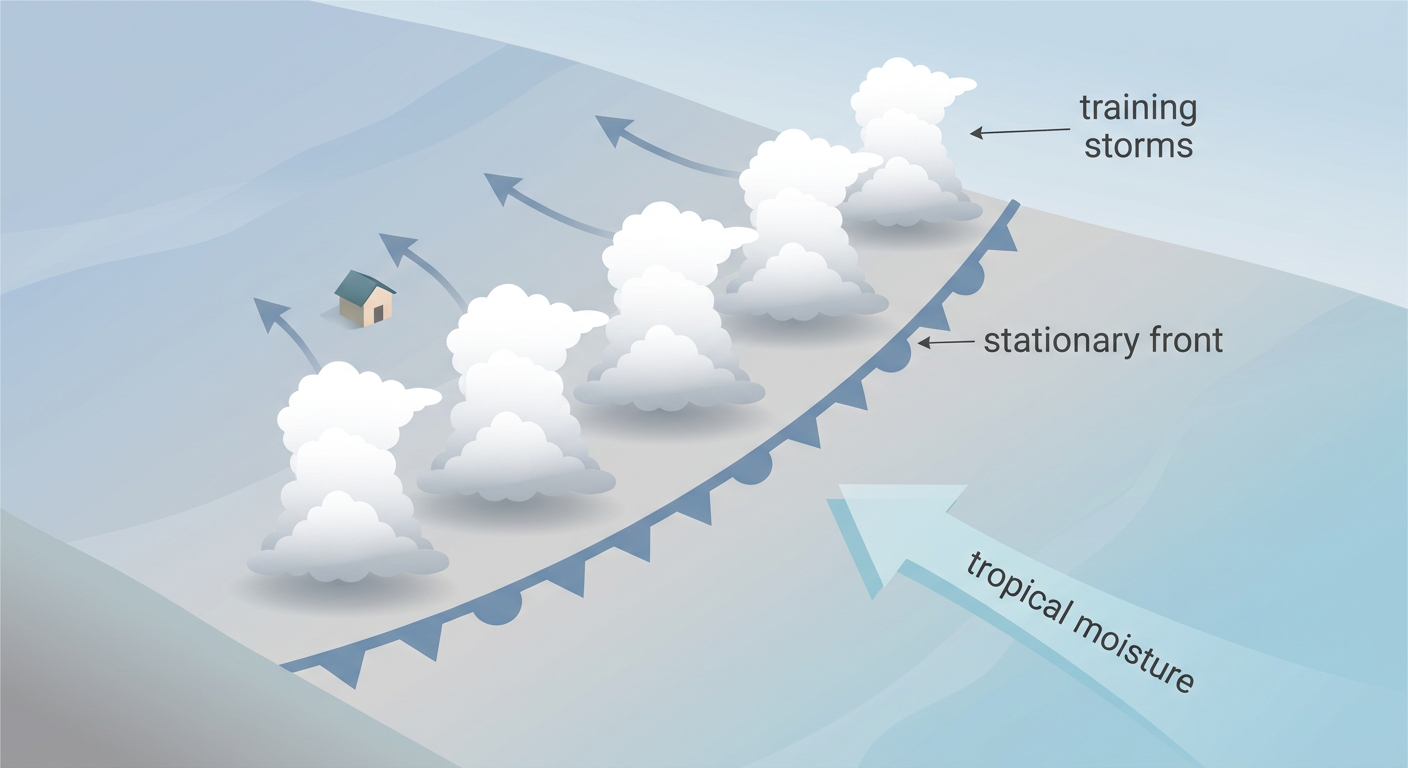
That's exactly what central Iowa lived through on the Fourth, when Polk City measured 13.5 inches in a single day. Different location, same recipe. This kind of setup has been the through-line of the whole week across the Plains, Midwest, and Northeast.
The Severe Side of Tonight
The rain gets the headline, but there's a wind story too. The Storm Prediction Center has a Slight Risk for severe storms across the Mid-Atlantic, including Philadelphia, Washington, and Baltimore. The main threat is damaging wind gusts, 60 mph or better if the strongest storms get going, in an unstable, muggy airmass east of the Blue Ridge.
For tomorrow, Monday, the moderate rainfall risk shifts and hangs on across the coastal Mid-Atlantic from Delaware up to Connecticut. That's the I-95 corridor, the densely packed stretch where water has nowhere to go but into storm drains and low spots. Flash flooding in a city is a different animal than in a field. The pavement doesn't soak anything up.
What This Means for the Fun Stuff on the Calendar
The World Cup Final is the marquee event, but it's not the only thing on the summer schedule in weather's path.
- MLB All-Star Game, Philadelphia, July 14. Right in the heart of the region that keeps getting these training setups. Worth watching as it gets closer.
- Musikfest, Bethlehem, PA, July 31. Ten days of music in eastern Pennsylvania, the same zone under tonight's Moderate Risk.
- The Aspen Festival Orchestra, Colorado, tonight. Different region, but Colorado's been dealing with its own thunderstorms and wildfire concerns, with news out this week that storms, heat, and wind are complicating containment efforts on the fires out there.
And for tonight specifically, if you're one of the folks heading to a ballgame in the Northeast, the Twins at Yankees in the Bronx or the Pirates at Nationals in DC, keep half an eye on the sky. Pop-up storms in this airmass can turn a pleasant evening into a rain delay fast.
The Bigger Picture
History says July storms in this part of the country can be more than nuisance rain. Pennsylvania saw significant tornado damage, including an EF3, on July 29, 2021. Maryland logged an EF2 with an injury on July 23, 2017. I'm not telling you to expect that tonight. The setup right now favors wind and water, not widespread tornadoes. But it's a reminder that summer storms here have teeth, and the training-rain threat is the one to respect this go-round.
Temperature-wise, this isn't the extreme heat the Northeast baked in earlier this month, when heat indices climbed toward 120 degrees. Philadelphia's normal early-July high sits around 87. The clouds and rain will keep things closer to seasonable, which is honestly a small mercy after that heatwave.
The Takeaway
The World Cup Final will draw eyes from every corner of the globe to a stadium in New Jersey. Between now and then, the sky over that same region is running the same play it's run all week: Gulf moisture, a stalled front, and storms that line up and pour. I can't forecast July 19 tonight. What I can tell you is the pattern to watch, and how to read it when the day gets close. If you've got outdoor plans in the Mid-Atlantic over the next couple of days, check the radar before you head out and give the flooded roads a wide berth. Turn around, don't drown isn't just a slogan. It's the whole ballgame.