Weather news
Earth's most above-normal day on record: +2.2°F on Friday, Nov. 20
By Ryan Hall, Y'all Weather Desk · Published
Written by our automated news desk from National Weather Service data.

Key points
- What: Friday, Nov. 20 was the most above-normal day for the whole Earth in the ERA5 record, at +1.228°C (+2.2°F).
- How we know: The value is final in the Copernicus Climate Pulse daily series, which we re-pulled at 6:55 AM ET Monday.
- Where it was warmest: Canada and Hudson Bay, Siberia and the Arctic. East Asia, the North Pacific and the Southern Ocean ran cold.
- What it means: This is not the hottest day in absolute terms. It is the largest departure from what is normal for that date.
The planet as a whole had its biggest gap above normal ever measured on Friday, Nov. 20, with the global average air temperature running 2.2°F (1.228°C) above the 1991-2020 normal for the date. The old record of +1.155°C was set on Nov. 17, 2023, in a dataset that goes back to 1940. Saturday's preliminary number is higher still.
What "warmest compared to normal" means
This record measures something different. It takes each day's global average and subtracts the 1991-2020 average for that same calendar date. Friday's gap, +1.228°C, is the biggest ever.
That is about 2.2°F above normal for the whole planet in a single day. A gap that size across the entire globe is large, because hot and cold spots usually cancel out.
Three record days in a row, and Saturday may top Friday
The old record fell on Nov. 19, when the gap hit +1.160°C. Friday then jumped well past it. Saturday, Nov. 21, came in at +1.267°C, but that number is preliminary and can still change. If it holds, Saturday takes the title from Friday.
Nov. 3 of this year also matched the 2023 record to three decimal places. That makes this a month of repeated high readings, not a single outlier.
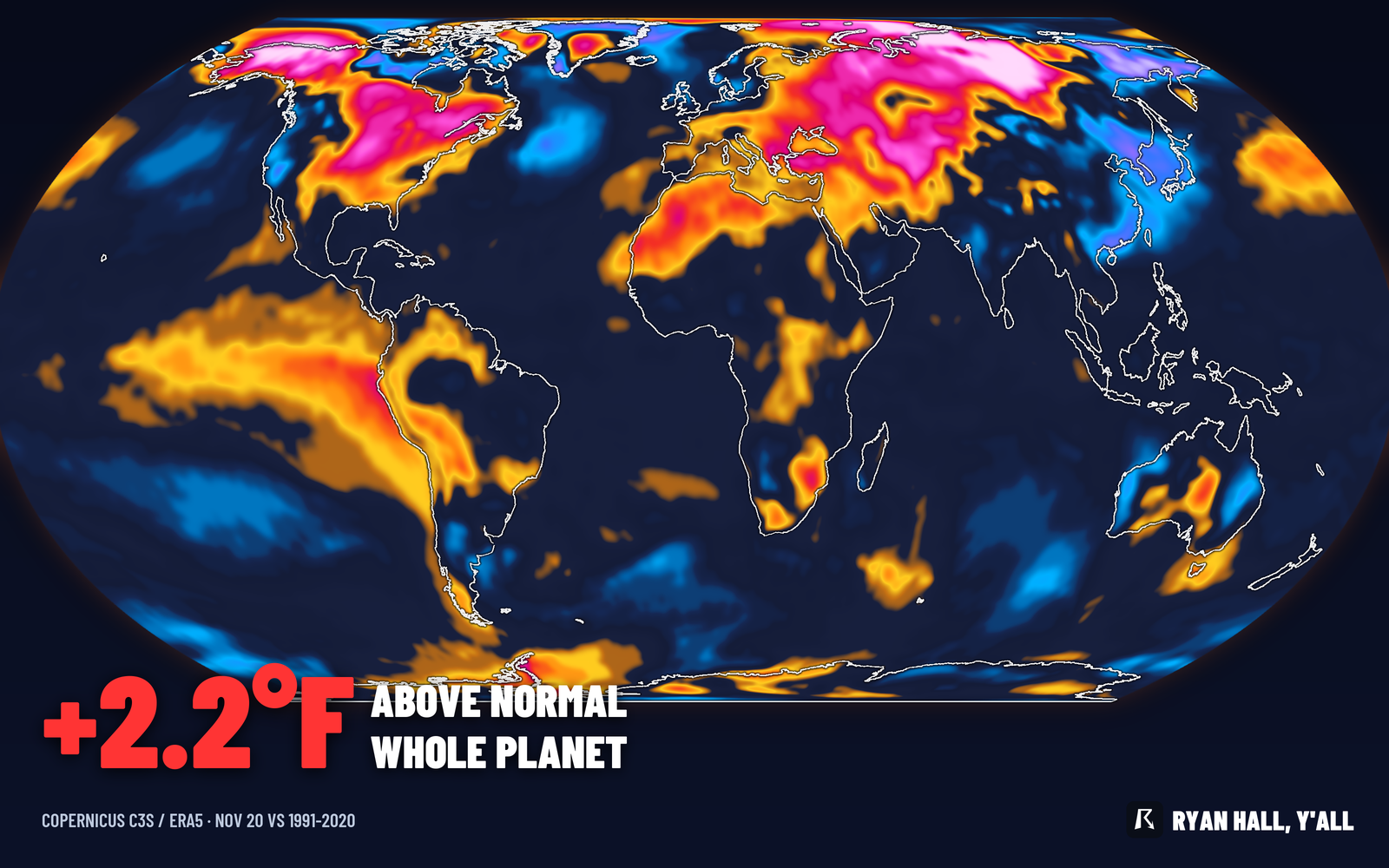
Where the heat was, and where it wasn't
On Friday, 73% of the Earth's surface ran above normal, weighted by area. The biggest departures sat over Canada and Hudson Bay, Siberia and the Arctic. Cold pockets covered East Asia, the North Pacific and the Southern Ocean.
So the record did not come from every place being hot. It came from big, intense warm areas in the far north outweighing the cold ones. One day also says little by itself about a long-term trend. Daily global numbers swing with the weather pattern, and the pattern on Friday happened to line up for warmth.
What it means for the lower 48
The sharpest warmth was north of the border and over the Arctic, not centered on the US. Parts of the East face a coastal storm this week. A Level 2 of 4 (Slight) flash flood risk is up for the Carolina coast on Wednesday, Nov. 25. That area runs from the Charleston area north to the southern Outer Banks, with 3 to 5 inches of rain possible. The same system could bring wet snow to interior higher terrain of the Northeast on Thursday and Friday, though the exact rain-snow line is still uncertain. Our winter outlook tracks that. If you're traveling for Thanksgiving, sign up for Y'all Alerts so warnings reach you on the road.
Bottom line
Friday, Nov. 20 is now the most above-normal day the planet has recorded, at +1.228°C (+2.2°F), and Saturday's early number is even higher. The warmth was concentrated in the far north, and a single day is a data point, not a trend.
| When | What | Note |
|---|---|---|
| 11/17/2023 | 1.16°C | Old record |
| 11/3/2026 | 1.16°C | Tied the old record to three decimals |
| 11/19/2026 | 1.16°C | Beat the old record |
| 11/20/2026 | 1.23°C | New record, final |
| 11/21/2026 | 1.27°C | Preliminary |
More on Weather records, November 2026
Sources
- Copernicus Climate Change Service ERA5, Copernicus Climate Change Service (ECMWF)
https://ryanhallyall.com/news/earths-most-above-normal-day-on-record-2-point-2f-on-friday-nov-20