Weather news
Edmund Fitzgerald sank at about 7:15 PM EST, 51 years ago tonight, on Lake Superior
By Ryan Hall, Y'all Weather Desk · Published · Updated
Written by our automated news desk from National Weather Service data.
What's new: Now gives the approximate 7:15 PM EST sinking time and NOAA's finding that the worst conditions fit into about six hours.
Key points
- Where: Southeast Lake Superior, just north of Whitefish Point, Michigan, in Canadian waters.
- When: About 7:15 PM EST on Nov. 10, 1975, inside a roughly six-hour stretch of the storm's most extreme conditions.
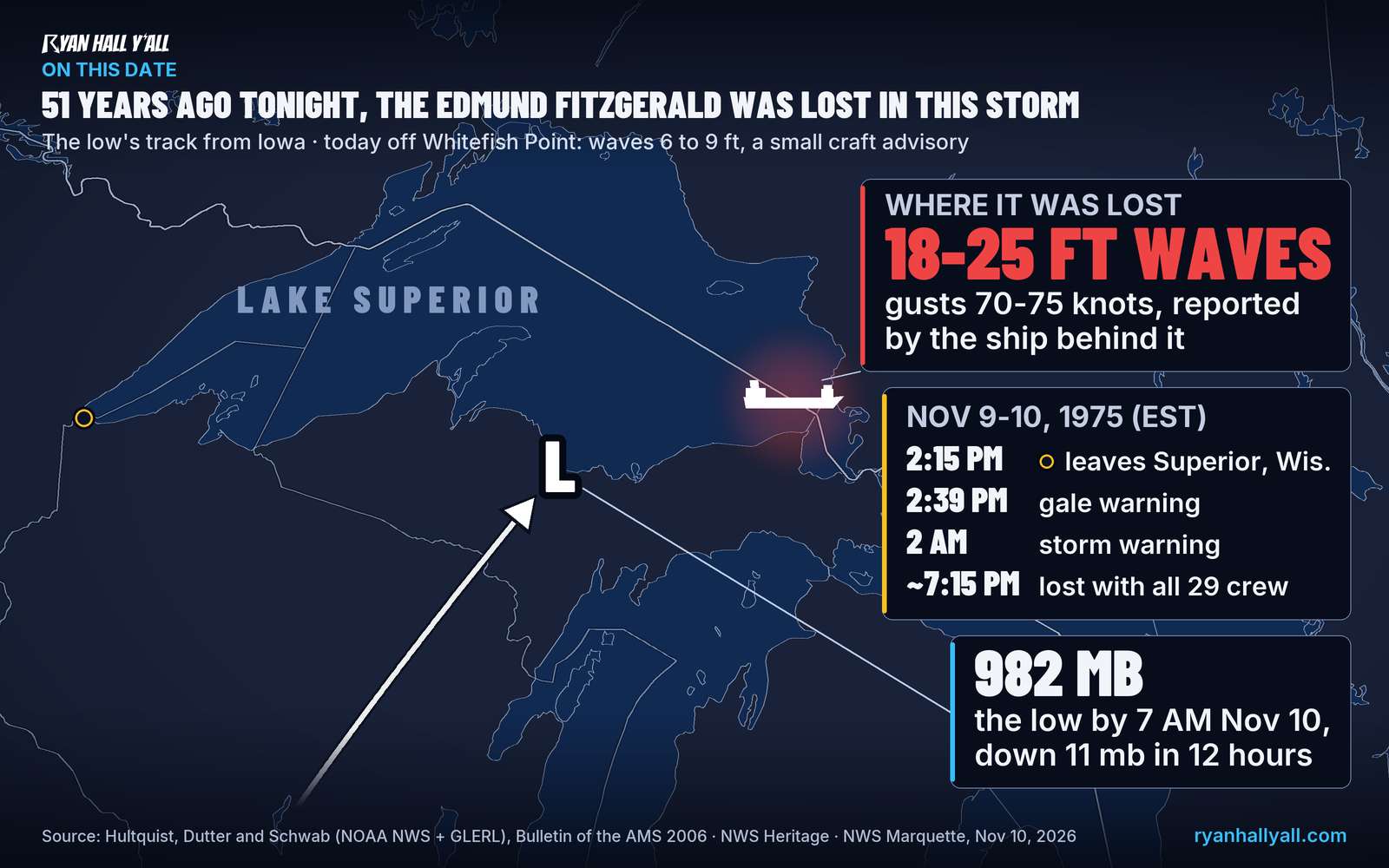
- What: A low pressure system strengthened as it moved from Iowa to near Marquette, Michigan. A ship following the Fitzgerald reported gusts of 80 to 86 mph and waves of 18 to 25 feet.
- What it means: The cause of the sinking is still debated. The weather record is clear about how violent the lake was that evening.
The Edmund Fitzgerald sank in southeast Lake Superior at about 7:15 PM EST on Nov. 10, 1975, and all 29 crew were lost. A NOAA study that rebuilt the storm with modern tools found its worst conditions were packed into about six hours that afternoon and evening, and the ship went down inside that window.
How the storm came together
The Fitzgerald left Superior, Wisconsin, at 2:15 PM EST on Nov. 9. A gale warning went up for Lake Superior at 2:39 PM, about 25 minutes later. At that point the storm was still organizing.
Overnight, the low tracked from Iowa toward Marquette and kept strengthening. The NOAA study found its pressure fell 11 millibars, to 982, between 7 PM EST Nov. 9 and 7 AM EST Nov. 10. A drop like that means the storm is winding up, and the winds climb with it. The gale warning became a storm warning at 2 AM EST on Nov. 10, a step up in expected wind strength.
{{CHART:0}}
The six hours that mattered
The same study found the most extreme conditions were confined to about six hours, in the late afternoon and early evening of Nov. 10. The Fitzgerald sank at 7:15 PM EST, inside that window.
The best eyewitness numbers come from the Arthur M. Anderson, the ship following the Fitzgerald. Its captain reported waves of 18 to 25 feet and gusts of 80 to 86 mph as it moved into the area where the Fitzgerald was lost. The National Weather Service's history page describes other ship reports from the storm, with winds reaching close to 60 mph and waves of almost 20 feet. Those are separate observations from different ships.
The wreck was later found in two large pieces on the lake bottom, just north of the international boundary. This post sticks to the weather. The cause is still debated.
Wednesday's storm risk in the lower Ohio and western Tennessee Valleys
No severe storms are expected today. Wednesday brings a Level 1 of 5 (Marginal) risk across parts of Kentucky, Tennessee, Indiana and Illinois, including the Nashville and Louisville areas.
Scattered storms should develop in the late afternoon and early evening near where the Mississippi and Ohio Rivers meet. They then spread east across southern Indiana, western Kentucky and northern Tennessee. A few isolated damaging wind gusts are possible. The storms won't have much fuel to work with, so the threat should stay localized.
The upper Great Lakes have a marginal winter weather risk Wednesday and Thursday. Thursday's risk also covers higher terrain in the interior Northeast. Anyone on the water up north should check the marine forecast before leaving the dock.
What to do
- Boaters and Great Lakes travelers: Treat a gale warning as a reason to change plans. The Fitzgerald left port shortly before one was issued.
- Anyone in the Nashville, Louisville and western Kentucky area Wednesday evening: Know where you'd shelter if a severe thunderstorm warning is issued. Our severe outlook has the latest.
- Anyone heading to the upper Great Lakes Thursday: Check the winter storm outlook before you go.
- Everyone: Sign up for free Y'all Alerts so a warning reaches your phone right away.
Bottom line
The Fitzgerald went down at about 7:15 PM EST, inside the roughly six hours when a deepening storm was at its worst, with gusts of 80 to 86 mph and waves up to 25 feet. Fifty-one years later, that storm is still a hard lesson in how violent Lake Superior can get.
| When | What |
|---|---|
| 2:15 PM EST Nov. 9 | Fitzgerald leaves Superior, Wisconsin |
| 2:39 PM EST Nov. 9 | Gale warning issued for Lake Superior |
| 2 AM EST Nov. 10 | Gale warning upgraded to a storm warning |
| Late afternoon and early evening Nov. 10 | Most extreme conditions, confined to abo |
| 7:15 PM EST Nov. 10 | Fitzgerald lost, all 29 crew died |
More on November 2026 weather
Places in this story: Marquette, MI; Whitefish Point, MI
Sources
- Bulletin of the AMS, May 2006, National Weather Service
- NWS Heritage, 'Tragedy on Lake Superior: The Sinking of the Edmund Fitzgerald', National Weather Service